You can beat information war through networked resistance
There are many ways to win against information warfare. The important part is to leverage its weaknesses and move in swarms.
Because we are networked through trade, the internet, travel, and other means, information warfare faces an increased threat of being turned against itself. For example, it is often considered to be in a state intelligence agency's best interest to encourage conspiracy theories in their rival countries. An example of this could be recent Kremlin-backed conspiracies in the US that 5G causes COVID-19, which in some unknown part led to people destroying 5G towers themselves or huge numbers of normal radio towers that they thought (incorrectly) were 5G. By spreading conspiracies that convince people in a rival country to attack telecommunication infrastructure, you increase the chance that the nervous system of that country will be disrupted or broken.
But conspiracies, as with any other type of information, are difficult to keep within one country. Russian state media has been found to spread COVID-related 5G propaganda, which while possibly contributing to the death toll in the United States, has also potentially spread into Russia having the third-highest death toll. There are over 32k posts about Qanon on VK (Russia’s Facebook) and there’s a Russian Qanon Telegram channel. In the modern world, we see conspiracies traveling between rival countries. This undesirable outcome is the result of the complex networks that define our contemporary era.
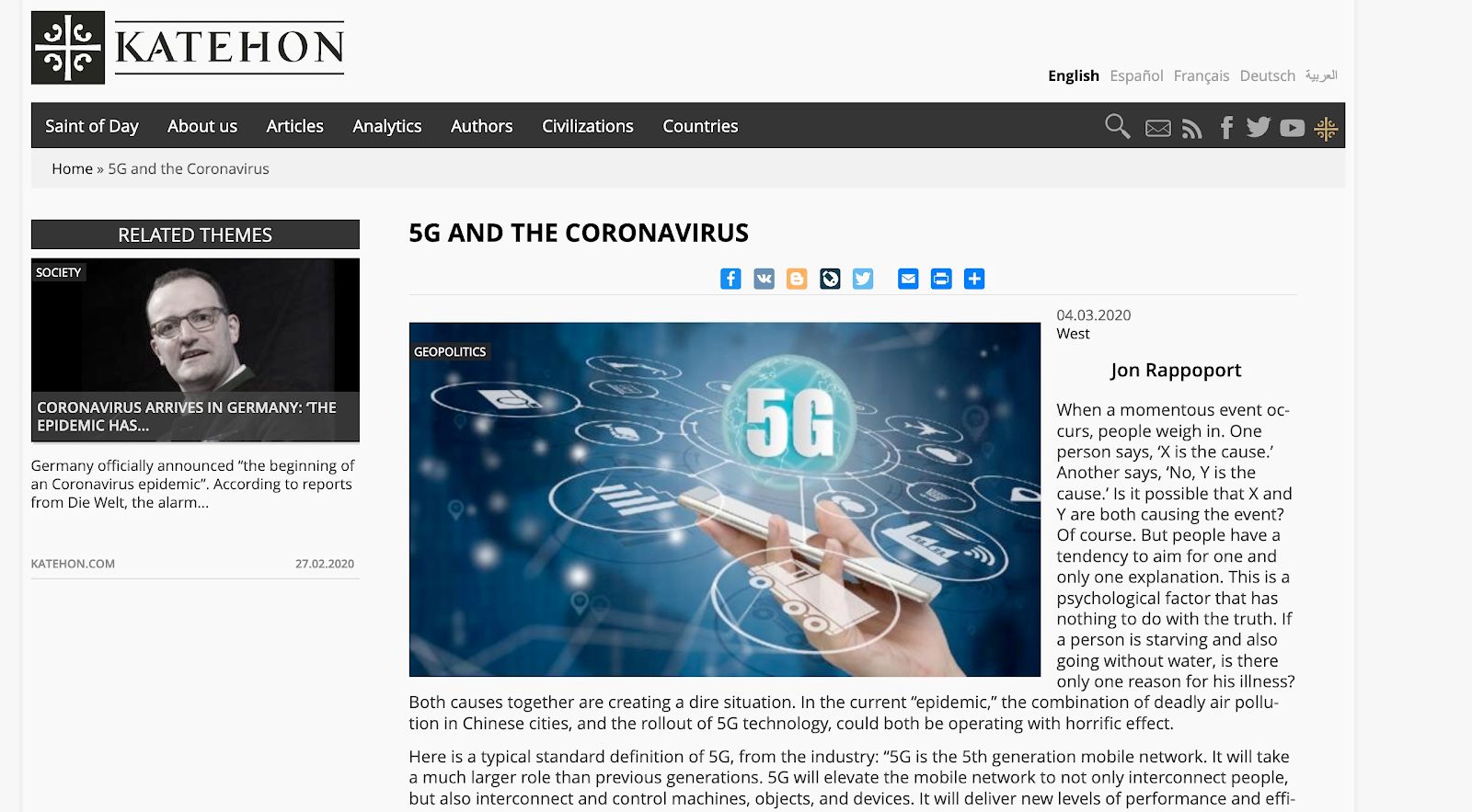
[Figure reproduced from PDF p35.]
Kremlin intelligence linked think tank Katehon spreads the conspiracy that 5G causes covid and that it was a US bioweapon. Subsequently, Russia has among the world’s highest COVID-19 death toll and has a Russian Qanon channel on Telegram.
Attempts at information isolation are leaky
Some states, such as the PRC and DPRK (and to a lesser extent Russia), attempt to mediate this by largely isolating their internet from the world, to increase the speed of response time to critical attacks. However, this requires a degree of authoritarian control over people, in which people’s internet can be even more tightly controlled than the modern capitalist form (a la Twitter, Facebook, etc). This positions a state well to both clamp down on dissent, but also control the broader flow of information including conspiracies.
However closed governments are more rigid and fragile in the face of change. Because they rely on subordinating individuals to function, they must suppress individual initiative and autonomy to retain power. The relation between those ruling and those being ruled becomes increasingly zero-sum because those being ruled can use any agency they seize to erode the control of the ruling class. The zero-sum nature of control means that society as a whole is less capable of responding to significant unexpected changes since interventions can only come from the central authority.1
On the other hand, a more open government and a strong civil society hurts the capacity of the state to get its way but makes the broader society far more effective at responding to complicated challenges without sacrificing individual freedoms. Again, Taiwan tells this story. In this podcast episode with Audrey Tang, they discuss how Taiwan was able to create grassroots resistance to conspiracy theories in a way that prevented actual COVID-19 outbreaks. In one example, through PTT, a Taiwanese social network similar to Reddit, they were able to quickly find out about and react to COVID-19 despite CCP-backed repression of the information initially. Another example Tang gave was that of a meme that was gaining popularity that claimed a person photographed was a HK thug from the protests who was supposedly responsible for multiple thefts. Despite these propaganda efforts people in Taiwan were able to discover that the user account was state-run and lying and then publicly shame them in a more viral way.
The power of networked resistance can also use swarms to build collective intelligence and solve problems through things like combining social media with open-source intelligence and other sense-making meta-tools, like SMAT, that help to visualize trends on social media.
Footnotes
Footnotes
-
The tradeoffs that autocracies face around information control are known as the “dictator's dilemma” wherein the ruling class would potentially benefit more transparency but risk social instability that might result. However openness and transparency carry risks of their own because of misinformation (see Henry Farrell and Bruce Schiner’s paper Common-Knowledge Attacks on Democracy for more) ↩